Flexible Pressure Sensor Research
Large-Area 3D Touch and Real-Time 3D Surface Scanning | Kitronyx Baikal II
How can electronic skin detect pressure across a large, flexible surface and visualize the results in real time?
How can signals from such a large-area pressure sensor array be acquired and visualized in real time?
This article introduces a study on a cellulose/carbon nanotube-based flexible pressure sensor developed for large-area 3D touch and real-time surface scanning.
In the study, Kitronyx Baikal II was used to acquire multichannel signals from the developed pressure sensor array, enabling real-time visualization of the pressure distribution through pressure mapping software.
Paper Reference
Kim, D.; Lee, D. K.; Yoon, J.; Hahm, D.; Lee, B.; Oh, E.; Kim, G.; Seo, J.; Kim, H.; Hong, Y.
"Electronic Skin Based on a Cellulose/Carbon Nanotube Fiber Network for Large-Area 3D Touch and Real-Time 3D Surface Scanning."
ACS Applied Materials & Interfaces, 2021, 13, 53111-53119.
Research at a Glance
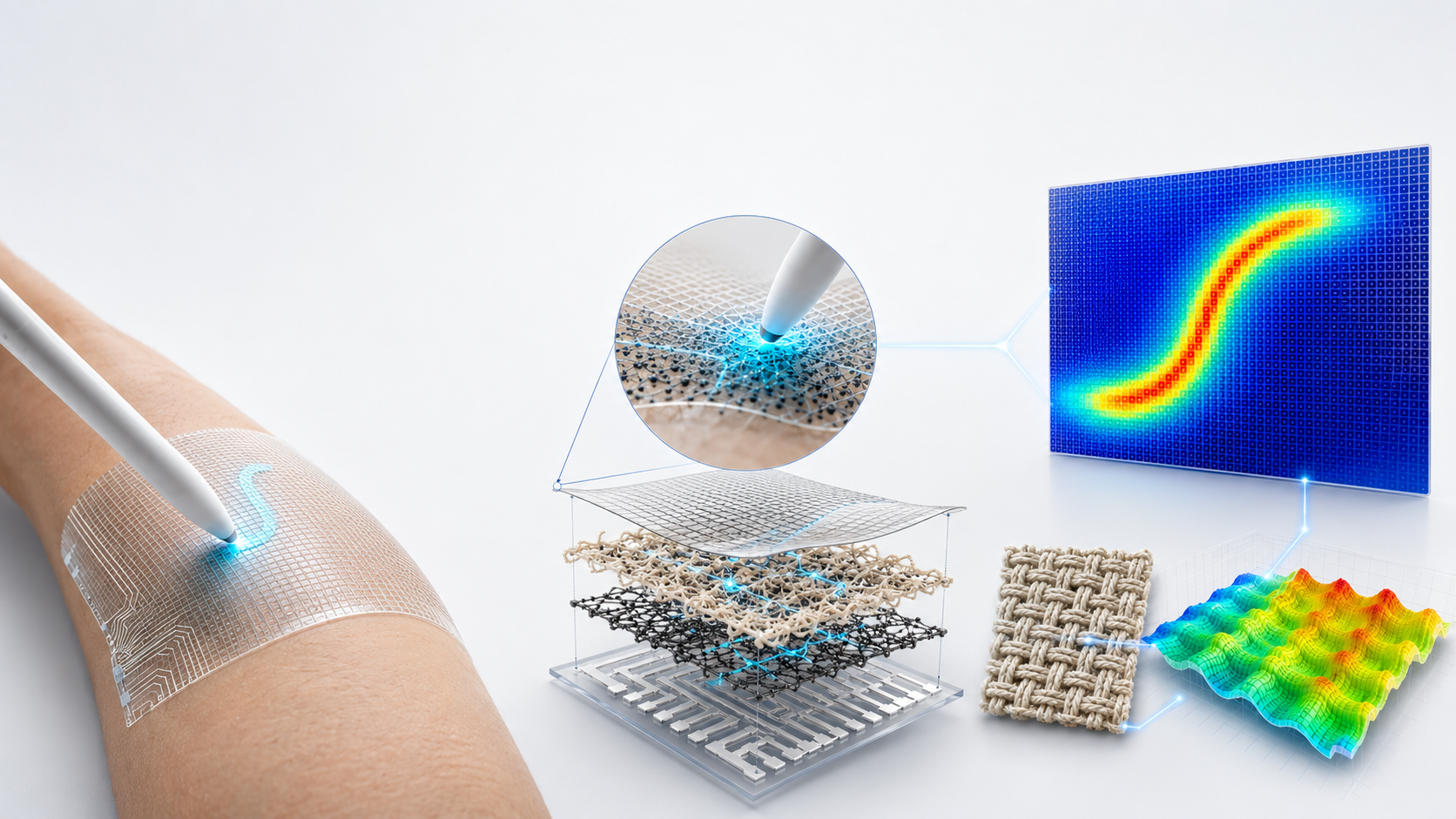
The study developed a large-area flexible pressure sensor array and evaluated its performance under various pressure and contact conditions.
| Category | Details
|
Research area
| Electronic skin (e-skin) and flexible pressure sensors
|
Main research topic
| Development and evaluation of a large-area flexible pressure sensor array
|
Number of sensing pixels
| 2,304 |
Key demonstrations
| Physiological signal measurement, wearable 3D touch, insect tracking, pen-pressure detection, and surface morphology scanning of woven textiles
|
Kitronyx product used
| Baikal II controller
|
Role of Baikal II
| Acquisition of multichannel signals for real-time pressure mapping |
▲ Overview of the referenced study (Kim et al., 2021).
Why Was a Large-Area Flexible Pressure Sensor Developed?
Electronic skin for robots and wearable devices must conform to curved surfaces while accurately detecting applied pressure. It also needs multiple sensing pixels across a large area to identify the location of contact.
Conventional tactile-sensor fabrication can involve fine patterning or complex chemical treatments, which can make large-area fabrication costly.
To address this limitation, the researchers used cellulose and carbon nanotubes as sensing materials and deposited the sensing material over a large area using a spray-coating process. The resulting pressure sensor array contained 2,304 sensing pixels.
How Was Kitronyx Baikal II Used in the Research?
Kitronyx Baikal II was used to acquire multichannel signals from the developed pressure sensor array.
The acquired data were then transferred to pressure mapping software for real-time visualization of the pressure distribution.
This measurement setup supported the evaluation of the sensor under various contact conditions, including insect tracking and surface morphology scanning of woven textiles.
Measurement Process
Pressure is applied.
Each sensing pixel generates an electrical response corresponding to the pressure applied at its location.
Baikal II acquires multichannel signals.
The controller’s data acquisition electronics measure multichannel electrical signals from the pressure sensor array.
The software visualizes the pressure distribution.
Pressure mapping software presents the contact location and pressure distribution in real time.
What Did the Flexible Pressure Sensor Demonstrate?
The flexible pressure sensor detected pressure as low as 1 Pa and operated at pressures up to 400 kPa. It achieved a sensitivity of up to 9.097 kPa⁻¹ and a response time of less than 2 ms.
In a cyclic durability test, the sensor underwent 10,000 loading-unloading cycles at 200 kPa. Its current response remained stable, with no significant change between the beginning and end of the test.
Test Item | Reported Result |
Detection limit | 1 Pa |
Maximum operating pressure | 400 kPa |
Sensitivity | Up to 9.097 kPa⁻¹ |
Response time | Less than 2 ms |
Cyclic durability test | 10,000 loading-unloading cycles at 200 kPa |
Result after cyclic test | Stable current response with no significant change |
Number of sensing pixels | 2,304 |
Source: Kim et al. (2021).
Note: The values above describe the flexible pressure sensor developed by the researchers and are not specifications of the Kitronyx Baikal II controller.
The pressure mapping system tracked a 28 mg insect as it crawled across the sensor and visualized contact location and relative pressure during pen input. It also revealed differences in the surface morphology of textiles with different weave patterns.
The researchers demonstrated additional applications, including physiological signal measurement and wearable 3D touch.
What Does This Research Show About Pressure Mapping?
A large-area pressure sensor array produces many individual electrical signals. These signals alone do not show how pressure is distributed across the entire sensing area. Pressure mapping converts them into a spatial view of contact location, movement, and pressure distribution.
Using the multichannel signals measured by Baikal II, the pressure mapping software visualized contact location, movement, and pressure distribution in real time.
This pressure mapping approach is relevant to the following research and evaluation areas:
E-skin development
Large-area flexible pressure sensor array evaluation
Robotic tactile sensing research
Wearable 3D touch evaluation
Surface morphology evaluation of textured materials
Conclusion
This study developed a cellulose/carbon nanotube-based flexible pressure sensor array containing 2,304 sensing pixels using a spray-coating process. Using the sensor, the researchers demonstrated physiological signal measurement, wearable 3D touch, insect tracking, pen-pressure detection, and surface morphology scanning of woven textiles.
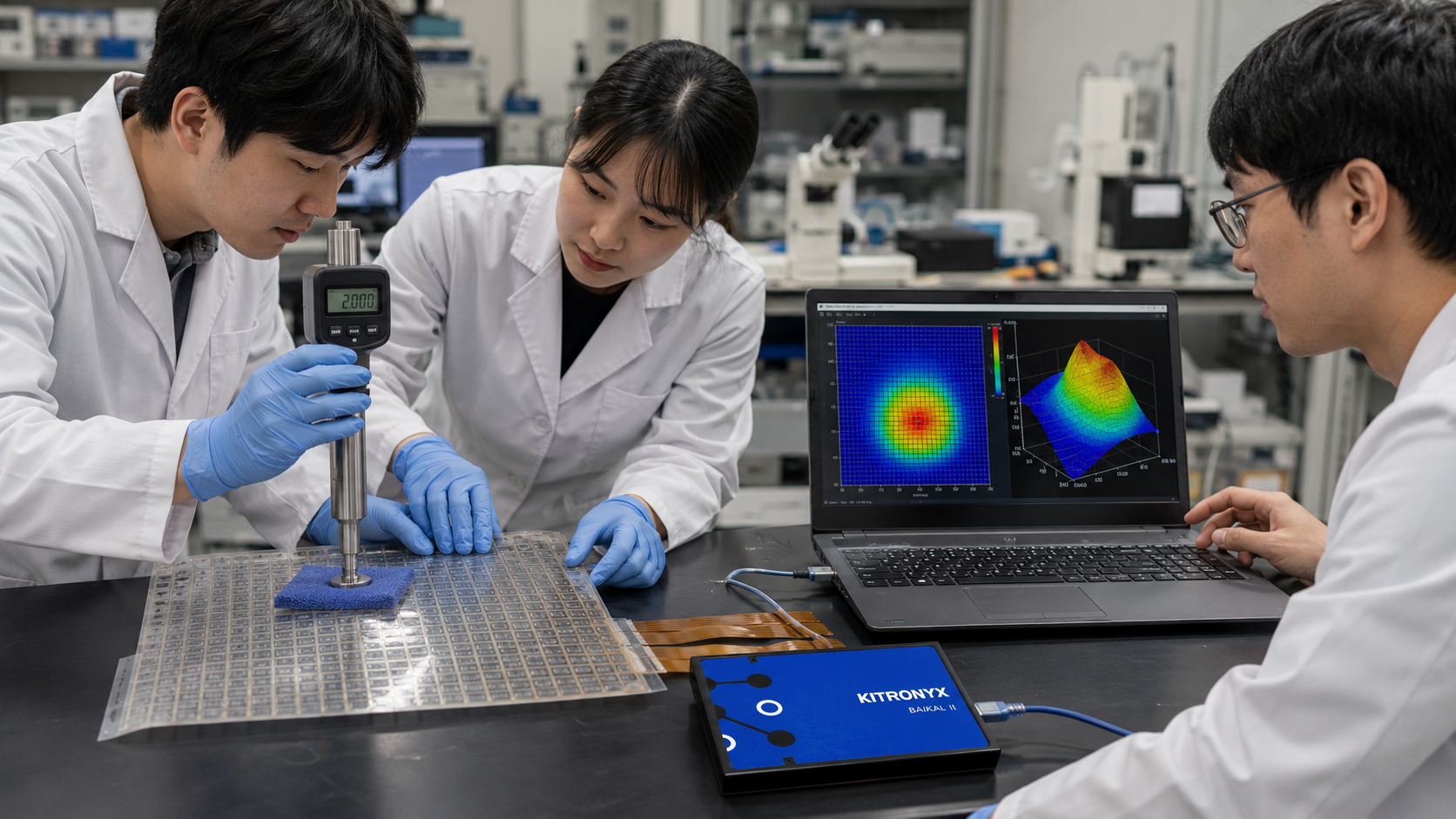
Baikal II supported real-time pressure mapping by acquiring multichannel signals from the pressure sensor array.
Explore Kitronyx Pressure Mapping Solutions
Kitronyx Pressure Mapping Systems can visualize contact location and pressure distribution in real time and can also be used to evaluate pressure distributions measured using custom-developed sensors.
> > Contact Kitronyx for product or application inquiries


Flexible Pressure Sensor Research
Large-Area 3D Touch and Real-Time 3D Surface Scanning | Kitronyx Baikal II
How can electronic skin detect pressure across a large, flexible surface and visualize the results in real time?
How can signals from such a large-area pressure sensor array be acquired and visualized in real time?
This article introduces a study on a cellulose/carbon nanotube-based flexible pressure sensor developed for large-area 3D touch and real-time surface scanning.
In the study, Kitronyx Baikal II was used to acquire multichannel signals from the developed pressure sensor array, enabling real-time visualization of the pressure distribution through pressure mapping software.
Paper Reference
Kim, D.; Lee, D. K.; Yoon, J.; Hahm, D.; Lee, B.; Oh, E.; Kim, G.; Seo, J.; Kim, H.; Hong, Y.
"Electronic Skin Based on a Cellulose/Carbon Nanotube Fiber Network for Large-Area 3D Touch and Real-Time 3D Surface Scanning."
ACS Applied Materials & Interfaces, 2021, 13, 53111-53119.
Research at a Glance
The study developed a large-area flexible pressure sensor array and evaluated its performance under various pressure and contact conditions.
▲ Overview of the referenced study (Kim et al., 2021).
Why Was a Large-Area Flexible Pressure Sensor Developed?
Electronic skin for robots and wearable devices must conform to curved surfaces while accurately detecting applied pressure. It also needs multiple sensing pixels across a large area to identify the location of contact.
Conventional tactile-sensor fabrication can involve fine patterning or complex chemical treatments, which can make large-area fabrication costly.
To address this limitation, the researchers used cellulose and carbon nanotubes as sensing materials and deposited the sensing material over a large area using a spray-coating process. The resulting pressure sensor array contained 2,304 sensing pixels.
How Was Kitronyx Baikal II Used in the Research?
Kitronyx Baikal II was used to acquire multichannel signals from the developed pressure sensor array.
The acquired data were then transferred to pressure mapping software for real-time visualization of the pressure distribution.
This measurement setup supported the evaluation of the sensor under various contact conditions, including insect tracking and surface morphology scanning of woven textiles.
Measurement Process
Pressure is applied.
Each sensing pixel generates an electrical response corresponding to the pressure applied at its location.
Baikal II acquires multichannel signals.
The controller’s data acquisition electronics measure multichannel electrical signals from the pressure sensor array.
The software visualizes the pressure distribution.
Pressure mapping software presents the contact location and pressure distribution in real time.
What Did the Flexible Pressure Sensor Demonstrate?
The flexible pressure sensor detected pressure as low as 1 Pa and operated at pressures up to 400 kPa. It achieved a sensitivity of up to 9.097 kPa⁻¹ and a response time of less than 2 ms.
In a cyclic durability test, the sensor underwent 10,000 loading-unloading cycles at 200 kPa. Its current response remained stable, with no significant change between the beginning and end of the test.
Test Item
Reported Result
Detection limit
1 Pa
Maximum operating pressure
400 kPa
Sensitivity
Up to 9.097 kPa⁻¹
Response time
Less than 2 ms
Cyclic durability test
10,000 loading-unloading cycles at 200 kPa
Result after cyclic test
Stable current response with no significant change
Number of sensing pixels
2,304
Source: Kim et al. (2021).
Note: The values above describe the flexible pressure sensor developed by the researchers and are not specifications of the Kitronyx Baikal II controller.
The pressure mapping system tracked a 28 mg insect as it crawled across the sensor and visualized contact location and relative pressure during pen input. It also revealed differences in the surface morphology of textiles with different weave patterns.
The researchers demonstrated additional applications, including physiological signal measurement and wearable 3D touch.
What Does This Research Show About Pressure Mapping?
A large-area pressure sensor array produces many individual electrical signals. These signals alone do not show how pressure is distributed across the entire sensing area. Pressure mapping converts them into a spatial view of contact location, movement, and pressure distribution.
Using the multichannel signals measured by Baikal II, the pressure mapping software visualized contact location, movement, and pressure distribution in real time.
This pressure mapping approach is relevant to the following research and evaluation areas:
E-skin development
Large-area flexible pressure sensor array evaluation
Robotic tactile sensing research
Wearable 3D touch evaluation
Surface morphology evaluation of textured materials
Conclusion
This study developed a cellulose/carbon nanotube-based flexible pressure sensor array containing 2,304 sensing pixels using a spray-coating process. Using the sensor, the researchers demonstrated physiological signal measurement, wearable 3D touch, insect tracking, pen-pressure detection, and surface morphology scanning of woven textiles.
Baikal II supported real-time pressure mapping by acquiring multichannel signals from the pressure sensor array.
Explore Kitronyx Pressure Mapping Solutions
Kitronyx Pressure Mapping Systems can visualize contact location and pressure distribution in real time and can also be used to evaluate pressure distributions measured using custom-developed sensors.
> > Contact Kitronyx for product or application inquiries